Juneteenth Guide← BringTheReceipts.org
June 19, 1865 — Juneteenth National Independence Day

A Guide for People
Who Want to Show Up

You want to acknowledge Juneteenth but you're not sure how. That's what this page is for. Not a lecture. Not a guilt trip. Just the history, the context, and some practical tools so you can engage with confidence.

This guide focuses on Juneteenth — its history, meaning, and how to engage with it. It is not intended to cover the full scope of racial injustice and inequality in America. For that broader context, see the Go Deeper section.
↓ Start reading

What Happened on June 19, 1865

On June 19, 1865, Union soldiers arrived in Galveston, Texas, and General Gordon Granger read aloud General Order No. 3: enslaved people in Texas were free. The crowd that gathered had no idea this moment was coming. Some had heard rumors. Most had not. Freedom arrived not as a grand announcement but as a soldier reading a paper on a street corner — two and a half years after Abraham Lincoln had signed the Emancipation Proclamation.

That gap wasn't an accident. The Emancipation Proclamation (January 1, 1863) applied only to Confederate states — and only in theory, with no Union troops to enforce it in Texas. Enslavers had every incentive to keep the news from reaching the people it freed. There is documented evidence that some messengers carrying the news were killed. The delay was deliberate.

This is why Juneteenth matters more than January 1st as a date. The Proclamation was a policy. Juneteenth was the moment freedom became real — at least on paper — for people who had been kept in bondage long after the law said they shouldn't be. It's not a celebration of Lincoln signing a document. It's a celebration of the day the news finally arrived.
From Then to Now

1863
Emancipation Proclamation signed (January 1)
Frees enslaved people in Confederate states — on paper. No enforcement mechanism in Confederate territory. Most enslavers ignore it.
June 19, 1865
General Granger reads General Order No. 3 in Galveston, TX
The moment enslaved people in Texas learn they are free. Two and a half years after the Proclamation. This is Juneteenth.
1866
First Juneteenth celebrations held in Texas
Freed Black Texans begin annual gatherings — praying, eating, and marking the day as their own Independence Day.
1980
Texas becomes the first state to declare Juneteenth an official state holiday
Championed by state legislator Al Edwards after years of effort. 115 years after the event itself.
2021
President Biden signs the Juneteenth National Independence Day Act
House vote: 415–14. Senate vote: 98–0. One of the most bipartisan bills in recent memory. It took 156 years from the event itself to federal recognition.
Today
47 states recognize Juneteenth — but most workers don't get it as a paid day off
Federal employees and many large employers observe it. Millions of hourly and service workers still do not.

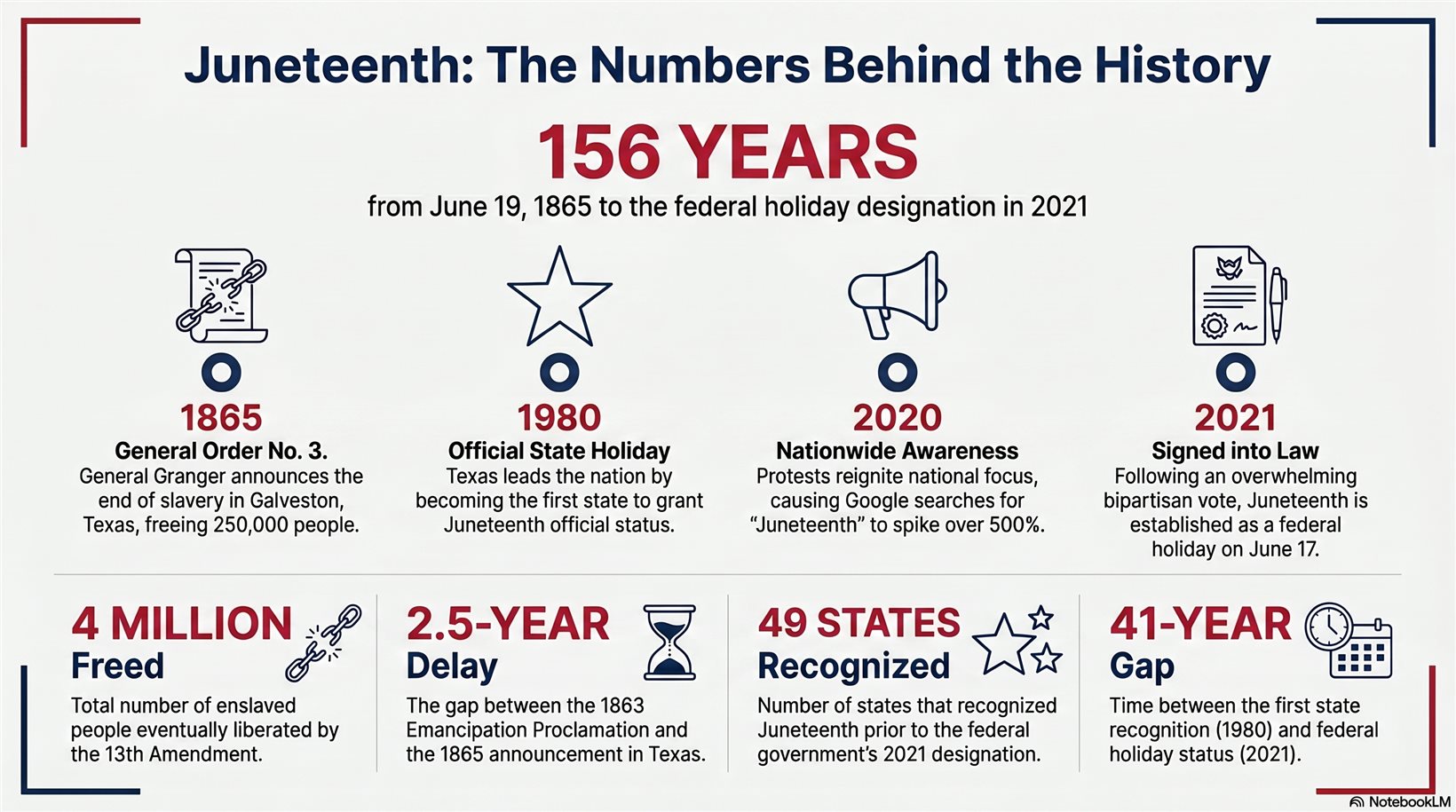
The Numbers Behind the History

Juneteenth: The Numbers Behind the History — infographic showing 156 years from 1865 to 2021, key milestones, and statistics including 4 million freed, 2.5-year delay, 49 states recognized, and 41-year gap to federal holiday

Generated with NotebookLM · Sources: National Archives, Library of Congress, Congressional Record

The Juneteenth Flag

Designed in 1997 by Ben Haith, founder of the National Juneteenth Celebration Foundation. Every element carries specific meaning — it's not decorative, it's a statement.

The Juneteenth flag — blue field on top, red field on bottom, separated by a white arc, with a 5-pointed star surrounded by a 12-ray nova burst at center
Blue (top) — The sky above the horizon; freedom and the enduring connection of Black Americans to the American story
Red (bottom) — The ground soaked with the blood and sacrifice of enslaved people and their descendants
White arc — The new horizon of opportunity for Black people; the line where ground meets sky
5-pointed star + 12-ray nova burst — The Lone Star of Texas (where freedom was announced) surrounded by a burst representing all 50 states and a new beginning for all

Design: Ben Haith (1997), refined by Lisa Jeanne Graf. Source: National Museum of African American History & Culture

Three Things People Get Wrong

Slavery ended with the Civil War
The Emancipation Proclamation (1863) only applied to Confederate states — and only on paper, with no enforcement. Slavery wasn't fully abolished until the 13th Amendment was ratified in December 1865, months after Juneteenth. Even then, debt peonage and convict leasing kept millions in de facto bondage for decades. The Civil War's end and the end of slavery are not the same moment.
Republicans made it a federal holiday — the work is done
True that the Juneteenth National Independence Day Act passed with bipartisan support in 2021, and Trump had advocated for federal recognition. That matters. Also true: most American workers still don't receive Juneteenth as a paid day off. Federal employees and many large corporations observe it — hourly, retail, healthcare, and service workers often don't. Recognition is a starting point, not an endpoint.
This isn't my history to celebrate
You don't need a personal connection to value freedom becoming real. July 4th celebrates an ideal — independence declared. Juneteenth celebrates its reality — freedom actually arriving for people who had been denied it. One completes the other. Engaging with Juneteenth isn't about claiming someone else's experience. It's about acknowledging that freedom deferred isn't freedom.

How Juneteenth Is Actually Celebrated

This isn't just a day of solemn remembrance — it's a living celebration with deep traditions. Here's what it looks and sounds like.

🍓 The Red Food Tradition

Red foods and drinks are a Juneteenth staple dating back to the original 1866 celebrations — red velvet cake, strawberry soda, red punch, hibiscus tea. The origin is debated: some scholars trace it to West African traditions around red palm oil and kola nuts that arrived with enslaved people; others connect it to the practical symbolism of abundance and celebration in the early Texas observances. Either way, red on the table is a living thread connecting generations of celebration.

🤠 Rodeos and Barbecue

The original Juneteenth celebrations were Texas affairs — outdoor gatherings, barbecue, and rodeos. That's not accidental: Black cowboys were a significant part of post-Civil War Texas life. Historians estimate that 1 in 4 cowboys in the 1860s–1880s was Black. The Juneteenth rodeo tradition in Hempstead, Texas has roots going back to 1867. The barbecue tradition reflects the communal, outdoor character of those first celebrations and continues in cities across the country today.

🎵 The Music

Juneteenth has always had a soundtrack. The early celebrations featured spirituals and gospel. As the 20th century unfolded, that thread ran through the blues, jazz, soul, and R&B. Artists whose work connects directly to the Juneteenth story: Nina Simone (Mississippi Goddam, To Be Young, Gifted and Black), Stevie Wonder (Happy Birthday, written as a protest song), Beyoncé's Lemonade and Black Is King, and H.E.R.'s "Fight for You." Many cities now host free Juneteenth concerts — check your local listings.

⛪ The Church

Black churches were the original organizers of Juneteenth — gathering freed people for prayer, scripture, and community in 1866, and every year since. That tradition is very much alive. Many Black churches today hold Juneteenth services that are open to the community. If you want to attend something meaningful and intimate rather than a large public festival, a local church service is worth looking for. You don't need to be a member or even a churchgoer — just call ahead and ask if visitors are welcome.

What to Say, What Not to Say

What to say

  • "Happy Juneteenth" is perfectly fine. You don't need the perfect words.
  • "I'm learning more about Juneteenth this year — do you have any recommendations?"
  • Ask questions that invite, not interrogate: "Is this something your family celebrates?"
  • Acknowledge the day at work the way you would any significant holiday.

What not to say

  • "I don't see color" — well-meaning, but dismisses lived experience rather than honoring it.
  • Asking a Black colleague to explain Juneteenth to the room — that's their labor, not their obligation.
  • "At least we made it a federal holiday" — minimizes how recent and incomplete that recognition is.
  • "I had no idea" repeated more than once — centers your learning over their experience.
  • "Do you celebrate it?" as a cold opener — let people share what they want to share.

At work

If your company doesn't observe Juneteenth, here's a low-stakes way to raise it:

  • "I noticed we don't have Juneteenth on our holiday calendar — is that something we could look at for next year?"
  • Frame it as a question, not an accusation. Bring data: SHRM tracks which peer companies observe it.
  • Don't ask a Black colleague to make this ask on behalf of everyone. That's not their job.

Practical Things You Can Do Today

Buy Black

Find Black-owned businesses near you or online — food, clothing, services, books.

Official Black Wall Street →

Attend

Most local events are free and explicitly welcome everyone. Also check your city's official .gov events calendar.

Donate

Support the organizations doing the legal and historical work — NAACP Legal Defense Fund, Equal Justice Initiative, and more.

Give via Aitruist →

Books & Films (Adults)

Where to go deeper — available via Bookshop.org (supports independent and Black-owned bookstores) and major streaming services.

  • Caste — Isabel Wilkerson. The framework for understanding racial hierarchy in America. Start here.
  • Between the World and Me — Ta-Nehisi Coates. A letter to his son about what it means to inhabit a Black body in America.
  • The Half Has Never Been Told — Edward Baptist. The economic engine slavery built, told through primary sources.
  • 13th (Netflix, 2016) — Ava DuVernay's documentary on the 13th Amendment and mass incarceration. 100 minutes.
  • Just Mercy (2019) — Bryan Stevenson's story and the Equal Justice Initiative. Widely available to stream.

Teach Your Kids

Age-appropriate books, available via Bookshop.org (supports independent and Black-owned bookstores).

Trusted Places to Learn More

Organized by type. These are institutions, not pundits — primary sources where possible, nonpartisan everywhere.

Quick Context (5–10 min)

Deep Dives

Primary Sources

For Educators & Kids

Prompt Library

Copy any prompt below and paste it into Claude.ai, ChatGPT, or any AI. Fill in the [bracketed] parts with your details.

X / Twitter Facebook WhatsApp Email Copy link